
Analysis Is Not the Point
People Analytics has spent fifteen years getting better at producing analysis. It still doesn’t reliably change decisions. The reason is hiding in plain sight.

This is the first of a 2-part mini-series on why People Analytics needs to shift from analysis to decisions. The second part is here.
The field’s uncomfortable moment
Speaking to practitioners at People Analytics conferences over the past couple of years, I’ve noticed a change in the atmosphere. The optimism of the early 2010s — when building the team, landing the technology, and proving that HR could do numbers felt like the whole job — has given way to something more unsettled. The dashboards are built. The tools are funded. And yet.
The data bears this out. According to HR.com’s State of People Analytics 2024–25, around three-quarters of organisations now invest in people analytics teams and technology. Just one in ten reports consistently achieving the highest level of impact with them. Decisions about who gets promoted, who gets hired, who gets managed out are still being made largely on instinct. Engagement scores are tracked and reported; little changes. Months of careful analysis sit in presentations that informed no decision in particular.
The field’s response has been consistent: better data, more AI, improved data literacy among managers, a closer seat at the executive table. These diagnoses were being offered in 2015. Progress has been modest.
I think the problem is upstream of all of them.
Treating the symptoms
The standard diagnoses are not wrong. Data quality problems are real. Many managers genuinely lack the confidence to work with quantitative evidence. Integration between people data and operational or financial data remains poor in most organisations. These are genuine barriers and they are worth addressing.
But here is a useful test: imagine you fixed every one of them. Your data is clean and fully integrated. Your CHRO presents at every board meeting. Your managers are fluent with numbers. You have still not guaranteed that a single important decision gets made better as a result of your work.
Technical and political improvements are necessary but not sufficient. The failure mode is not technical and it is not political. It is conceptual — a confusion, running deep through the discipline, about what analysis is actually for.
The means and the end
The purpose of analysis is to improve decisions. Analysis that does not change a decision has no value.
This sounds obvious. Its implications are radical.
It means the quality of an analytical project cannot be judged by the quality of the analysis. A technically excellent model, properly validated, beautifully presented, is worthless if it does not change how a decision is made. The question “was this good analysis?” is almost entirely the wrong question. The question that matters is “did this help someone make a better decision?”
And it means that everything upstream of the analysis — how the problem is framed, what decision is being supported, who makes the decision and how — is at least as important as the analytical work itself.
The field has invested heavily in getting better at producing analysis. It has invested almost nothing in the conditions that would make that analysis matter.
Asking the wrong question
Consider a scenario that will be familiar to most practitioners. An organisation is concerned about employee turnover. The people analytics team is asked to investigate why people are leaving. They build a solid predictive model — a proper piece of work, well-specified, appropriately validated. The top drivers of attrition are identified. Recommendations follow. Among the most tractable interventions, it turns out, is stress caused by a feeling of too much work: if you reduce the pressure on borderline performers, total attrition falls. The project is declared a success.
Except: the attrition that falls is largely among poor performers, who were inexpensive or actively beneficial to lose. High performer attrition — costly, often irreversible — has actually increased as they struggle to differentiate themselves from the average. The firm is now measurably better at retaining people it would prefer to lose. Objectively, the decision made things worse. The analysis, throughout, was technically sound.
The error was made before the first line of code was written. The frame was wrong.
The real decision facing the organisation was not “how do we reduce turnover?” It was “how do we manage the cost and impact of turnover on the business?” These are not the same question. They require different analyses, yield different findings, and lead to entirely different actions. The analytical output could be identical; what changes is the decision it serves.
Ronald Howard, who coined the term “decision analysis” at Stanford in 1966, spent much of his career arguing that framing is the most consequential and least discussed step in any analytical process: “The frame is the most important thing, and it’s the one that’s talked about the least — otherwise, you’re going to get the right answer to the wrong problem.” Russell Ackoff, who built the discipline of Operations Research at Wharton across the same decades, put it with characteristic sharpness: “The righter we do the wrong thing, the wronger we become.”
The turnover case is not a horror story about analytical malpractice. It is the default pattern when an analytics team accepts the question it has been handed rather than examining the decision it is supposed to serve.
One link in a longer chain
Even when the frame is right, there is a further problem. Most analytics work treats information as the product — and stops there.
Carl Spetzler, Hannah Winter, and Jennifer Meyer, in Decision Quality (2016), codified what Ronald Howard’s group had been teaching at Stanford for decades: a good decision requires six things to be in place simultaneously, each of which can cause the whole enterprise to fail if it is weak. They are rendered as links in a chain — appropriate framing, creative alternatives, meaningful and reliable information, clear values and trade-offs, sound reasoning, and commitment to action.
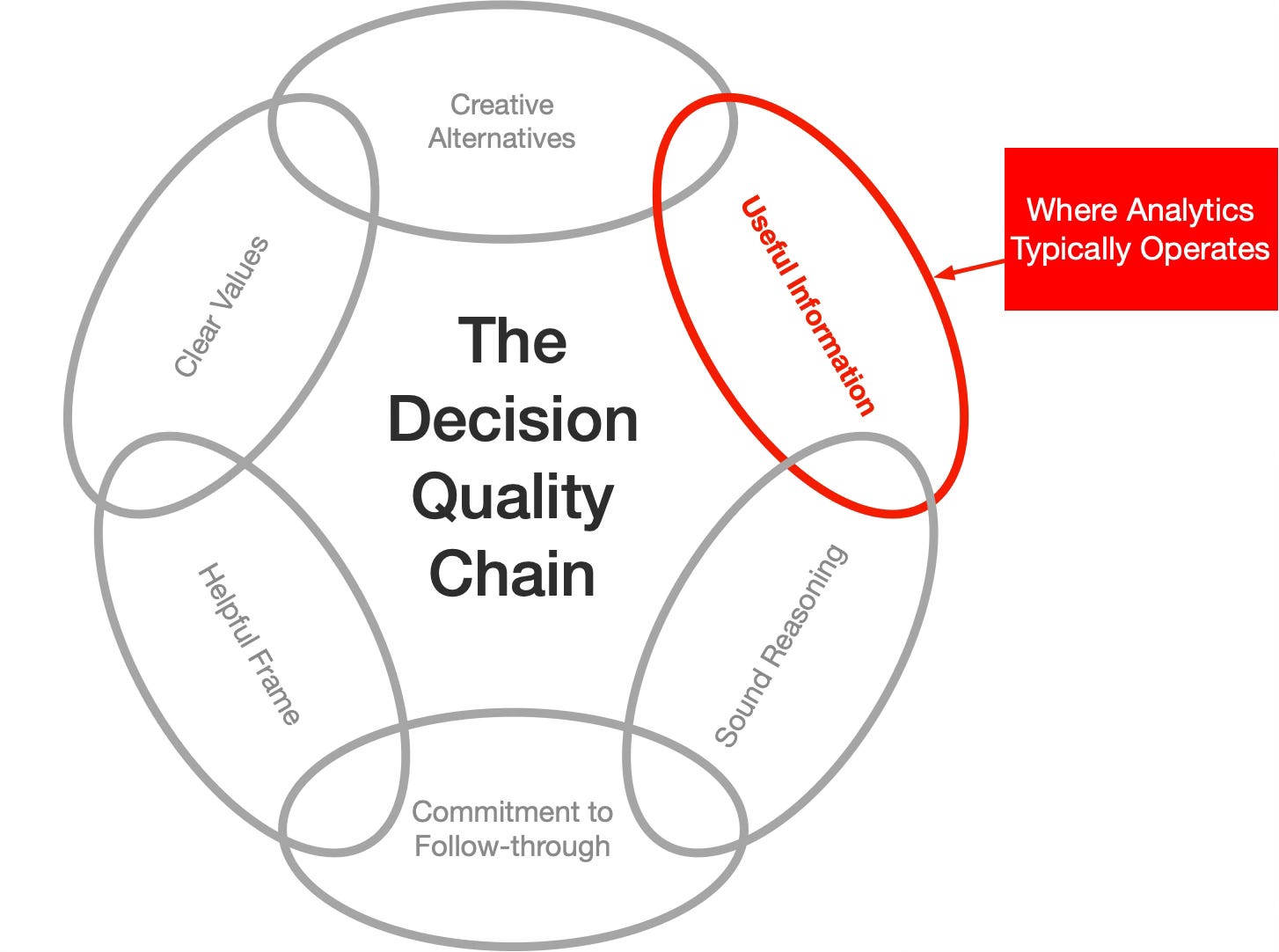
People Analytics, even when it is working well, almost exclusively provides one of these: information. A predictive attrition model tells you that a given employee has a high probability of leaving in the next six months. It does not tell you what you could actually do about it — the alternatives link. It does not encode whether retention is worth the cost in this particular case — the values link. It does not tell you how the decision will be made or by whom — the commitment link.
The chain is only as strong as its weakest link. A brilliant model that informs a poorly framed decision, with no good alternatives considered and no clear owner of the final call, is not a successful piece of analytics work. It is a technically impressive contribution to a failed decision process.
The discipline has optimised for one link and treated the rest as someone else’s problem.
A gap in training — and what fills it
Understanding why this pattern persists requires an uncomfortable observation about how the people analytics profession is formed.
Decision theory has a substantial intellectual history. Howard’s decision analysis work in the 1960s built on earlier foundations in economics and mathematics: the expected utility theory developed by John von Neumann and Oskar Morgenstern, the subjective probability framework of Leonard Savage, the Bayesian statistical tradition. This body of work — which deals explicitly with how to frame decisions, how to reason under uncertainty, and how to connect analytical findings to choices — is standard in economics and Operations Research programmes. It is the intellectual infrastructure of those disciplines.
It is almost entirely absent from the training routes that feed People Analytics. Data scientists are taught to build models. I/O psychologists are taught to design studies and interpret results. HR professionals are taught organisational behaviour and employment law. Almost none of these routes touch, even briefly, on decision theory. Practitioners arrive with genuine technical competence and no conceptual framework for what their work is meant to produce.
This is not a criticism of individuals. It is a structural observation about how disciplines are bounded, and about what happens when a field draws on multiple technical traditions without inheriting any of their foundational thinking about purpose. People Analytics is highly capable, technically. It simply was not taught what it is for.
There are other structural forces that reinforce the pattern. Analytics teams are typically evaluated on outputs — models delivered, dashboards built, reports produced — not on outcomes. Analytics technology is sold as an “insight generation” platform, positioning analysis as the destination rather than the route. And much of the push for evidence-based HR has been, at least in part, a campaign to prove HR’s numerical credibility to sceptical business audiences — which rewards analytical display more than decision facilitation.
A brief note on AI
Generative AI is changing the economics of analysis production rapidly, compressing into minutes work that previously took weeks. If the purpose of analytics is to produce analysis, this is an unambiguous improvement. If the purpose is to improve decisions — and the framing problem described above goes unaddressed — the field can now produce faster and more elaborate answers to the wrong question. Ackoff’s observation applies with some force.
What it looks like when done properly
Return to the turnover scenario, but start differently.
Before any data is pulled, the question is examined: what decision are we actually supporting? Not turnover reduction as an end in itself, but the management of turnover costs and impact — which means the relevant population is not all leavers but costly leavers, primarily high performers and people in hard-to-fill roles. This reframing changes what the model needs to do.
Alternatives are scoped before the model is built: what levers actually exist? Targeted retention packages, career development conversations, changes to management practice, doing nothing and improving hiring speed instead. The analysis is then designed to inform a choice between these options, not just to characterise a problem. And it is built around variables the organisation can actually change — a point the statistician Donald Rubin formalised as “no causation without manipulation.” Age and tenure may predict attrition well; neither is a lever. The decision owner is identified before the findings are presented. The values and trade-offs — what is a retained high performer worth, relative to the cost of a retention effort — are made explicit.
The analytical work may be similar in technical terms. The decision process it sits within is entirely different. And the probability that it changes something is vastly higher.
The real problem
The angst in People Analytics right now is real and appropriate. Paul Nutt, who spent twenty years studying more than four hundred management decisions for his book Why Decisions Fail (2002), found that the most common cause of failure was not poor analysis. It was premature commitment to the wrong problem — accepting a given framing without questioning whether it described the real decision at stake.
People Analytics has been committing, at scale, to the wrong problem. It has treated analysis quality as the thing to improve when the thing that matters is decision quality. Better dashboards, more AI, and improved data literacy will not fix this. They will produce righter answers to the wrong question.
The discipline does not need to be more analytical. It needs to understand what analysis is for.
Part II - How the profession should change

Sources: HR.com State of People Analytics 2024–25; Carl Spetzler, Hannah Winter & Jennifer Meyer, Decision Quality (Wiley, 2016); Paul Nutt, Why Decisions Fail (Berrett-Koehler, 2002); Ronald A. Howard, “Decision Analysis: Applied Decision Theory” (1966); Russell L. Ackoff, quoted in The Systems Thinker.