

We’ve all been there. You’ve a new screening tool that ranks applicants. Its own selection was the result of a careful study by your assessment team. The first time the list is presented to a real hiring manager you learn they read the list, passed over the name at the top and hired someone further down. A reason was given at the time but nobody recorded it, and nobody returns later to ask whether it was right.
This issue is not about whether an algorithm should decide who gets hired. It is about the narrower question of what happens when a model produces a recommendation and a person has the authority to set it aside.
Two recent issues - The validity coefficient and what it doesn’t tell you and What the validity evidence can’t see - asked which selection methods predict performance, and argued that a documented process deserves more trust than an impression. This one asks what changes when the method is a model, and when someone sits above it with a veto.
The question is older than the technology
The comparison between expert judgement and a mechanical rule has been repeatedly made.
In 1954 Paul Meehl published Clinical versus Statistical Prediction. He collected the studies then available, about twenty, in which experts and simple formulas - algorithms - predicted the same outcomes from the same information. The formulas matched or beat the experts in almost every case. Meehl was a practising clinician, and the book was written against his own profession.
Robyn Dawes took the argument further in 1979. Models that used equal weights, fitted to nothing, also did better than experts. Dawes’s explanation was that the expert’s problem is not the weights but consistency. The same person, reading the same file on a different day, reaches a different conclusion. A model applies the same rule every time. We’ll come to this later, as current ‘AI’ - LLMs - do not necessarily meet this criterion.
In 2000 William Grove and colleagues published a meta-analysis of the field - at this time 136 papers. Mechanical prediction was about 10% more accurate on average. Expert judgement was clearly more accurate in 6 to 16% of studies. The difference was larger when interview impressions, the method practitioners trust most, were among the inputs the expert used.
This result has also been replicated in other fields. In 2018 Jon Kleinberg, Sendhil Mullainathan and their co-authors examined pretrial release decisions and found that machine predictions of flight risk did better than the judges’. They estimated crime reductions of up to about 25% without holding more people in custody.
Back in 1954 Meehl allowed one exception, and it is the exception this essay is about. A model should be overruled when the person deciding knows something relevant that the model cannot see. His example was a prediction that a professor would go out that evening, made without knowing that the professor had broken his leg. The studies that follow measure how often the person overruling the model really does hold information the model lacks.
The research on algorithmic override has been making the same recommendation for more than seventy years. It does not say that judgement should be removed from a decision - in this case selection. It says that departing from a consistent rule costs accuracy.
What happened in fifteen firms
The clearest test of algorithmic overruling in hiring comes from Mitchell Hoffman, Lisa Kahn and Danielle Li, published in the Quarterly Journal of Economics in 2018.
Fifteen firms employing low-skill service workers introduced an online job test, at different dates. The test graded each applicant green, yellow or red. Managers were told to hire in score order, but were free to depart from it.
The test worked. Staff hired after it was introduced stayed about 15% longer. That fits an earlier study by David Autor and David Scarborough of 1,363 stores of a national retailer that moved from informal screening to a test: median tenure of new hires rose by more than 10%, and minority hiring did not fall.
The part of the result that I want to focus on concerns the managers who departed from the order. Where managers passed over green applicants to hire yellow ones more often, retention was worse than the scores implied.
A side note, though one that I’m going to cover in more detail in a couple of issues that will be published in the coming weeks. Retention is often the best way of measuring quality of hire. If we think of the expected gain from recruitment we need not only to think of the productivity of the hire but also the number of hires and their expected duration. As I note, “a hiring policy is a rate acting on a stock: its value accrues over every year a hire stays, and evaporates when they leave.” John W. Boudreau, in his 1983 paper, extended the Brogden/Cronbach-Gleser utility model in this manner:
ΔU = T × N × (r × SDy × z̄ − cost per hire)
The advantage of retention is that, compared to performance ratings, it is much less affected by measurement error. This should make it the People Analyst’s friend when doing these analyses.
Hoffman, Kahn and Li’s design added a clever twist that makes it, I feel, far more interesting. A candidate passed over at one firm was often hired later somewhere else in the same group, so their record can be observed. If managers had been overruling the test because they could see something it could not, the people they chose should have done better than the people they skipped. They did not. The passed-over candidates did better than the candidates hired ahead of them.
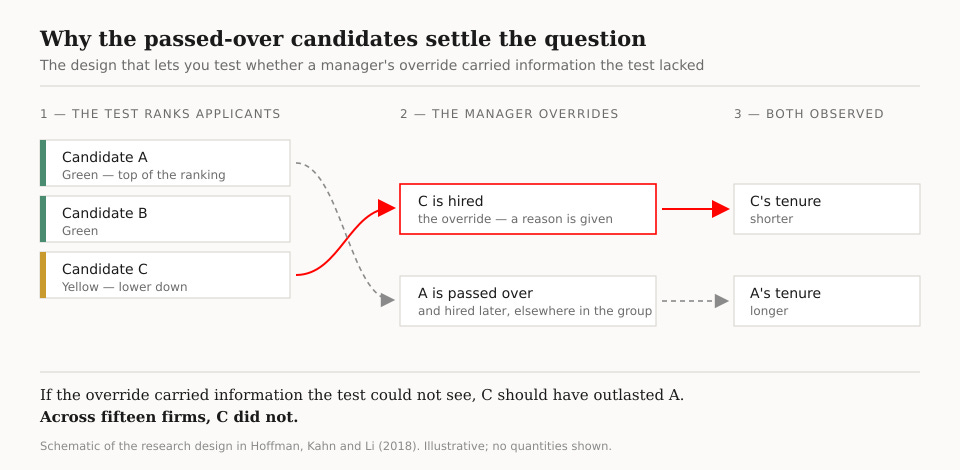
Schematic of the Hoffman, Kahn and Li design. A manager passes over green candidate A to hire yellow candidate C; A is hired later elsewhere in the group, so both records can be compared. C’s tenure was shorter.
The authors’ conclusion is that “biases, rather than superior information, account for the majority of instances in which managers exercise discretion”.
There are two things that should be noted with this paper. The outcome measured is retention, not rated performance, but as I’ve just noted I think that’s probably for the best. And the setting is low-paid work with high turnover, where tests perform well and individual fit matters least. Whether the same holds in senior professional roles has not been tested. That is the standard caution about single-industry evidence, and it applies to every study in this issue.
There is a reason to think the pattern is not confined to service hiring. The same asymmetry turns up in a field with nothing else in common with it.
Where overruling worked
Victoria Angelova, Will Dobbie and Crystal Yang studied pretrial decisions in a United States city between 2016 and 2020. Every defendant received an algorithmic risk score and a recommendation on release. Judges could follow it or set it aside.
Ninety per cent of judges made overrides that performed worse than the recommendation they set aside, and most of those were no better than random. The remaining ten per cent did better than the algorithm when they overruled it, on accuracy and on fairness at the same time.
The authors’ evidence suggests the second group were doing what Meehl described. They used information that reaches a courtroom but never reaches a risk score, and they reacted less to recent events that had been widely reported.
That changes the practical question. It is not whether managers should be allowed to overrule a screening tool. Some of them should. It is which ones, on what basis, and how a firm would know. Should the override itself require a process - an algorithm?
It is not that judgement and the model are about equally good and the truth lies between them. Nine judges in ten made the decision worse. The value sits with a minority, and there is at present no method for identifying that minority in advance. Is it even possible?
Why most overrides go wrong
Four mechanisms for what goes wrong are worth exploring in a bit more detail:
The first is the inconsistency Dawes identified. Judgement varies between occasions; a rule does not. Any departure from the rule puts back the variation the rule removed. Daniel Kahneman, Olivier Sibony and Cass Sunstein made this argument at book length in Noise in 2021.
The second is what Berkeley Dietvorst, Joseph Simmons and Cade Massey called algorithm aversion. In experiments published in 2015 they found that people stop relying on a model once they have seen it make a mistake, while continuing to rely on human judgement that makes the same mistake. Any real screening model will make visible mistakes, so distrust is the normal condition rather than an unusual one. Their follow-up study in 2018 carries the practical lesson: people who were allowed to adjust the model’s output slightly kept using it, and the cost in accuracy was small.
The third concerns experienced practitioners. Jennifer Logg, Julia Minson and Don Moore found in 2019 that people without expertise in a field weight algorithmic advice more heavily than human advice. It is professionals in the field who discount it. In their studies the forecasting professionals who discounted it were less accurate as a result.
The fourth is selective adherence. Astrid Rosenthal-von der Pütten and Alexandra Sach ran an experiment in 2024 in which participants received shortlisting advice that was sometimes biased against candidates with non-German names. Participants followed the advice when it agreed with what they already believed, and overrode it when it did not. About sixty per cent did not notice that the advice was biased at all. Moa Bursell and Lambros Roumbanis found the same behaviour in the field, in a study of recruiters at a large multi-site company: what they call meta-algorithmic judgments, the reasons given for setting the ranking aside in a particular case.
Together these say something specific about what a screening model does and does not do. A firm that uses a model - an algorithm, a tool - and leaves discretion unmonitored has not removed bias from its hiring. It has added a step that makes the outcome look more defensible.
What the model was built to do
None of this argues for trusting whatever a supplier provides. The word “algorithm” covers systems built to do different things, and the difference is measurable.
Danielle Li, Lindsey Raymond and Peter Bergman studied résumé screening at a Fortune 500 professional services firm, for a paper published in the Review of Economic Studies in 2025. They compared three approaches: the firm’s own screeners, a supervised model trained on the firm’s hiring history, and a contextual bandit model that scores applicants partly on how uncertain its estimate is.
The supervised model reproduces the pattern of past selection, good or bad. That has a statistical cost before it has any other kind. For the sorts of applicant the firm has rarely hired, often senior hires with unique roles, the model’s estimates are uncertain purely because the firm does not hire them and so never produces the outcome data that would improve them.
The bandit model samples where the firm knows least. It did better than both the human screeners and the supervised model on the quality of the candidates selected. In the paper it also more than doubled the share of Black and Hispanic candidates selected, from 10% to 23%. The supervised model reduced that share.
The same technique, applied to the same data, produced opposite results depending on what it was built to do. That is worth remembering when a supplier says they’ve got an AI screening tool. The statement carries almost no information. The questions that carry information are what the model was trained to predict, whose hiring history it was trained on, and whether it ever samples applicants it knows little about. It’s of course worth understanding the supplier’s definition of fairness, which I explored in Issue 13: a hiring tool has already chosen a definition of fairness, whether or not anyone chose it deliberately.
What generative AI changes
Everything so far concerns a model scoring a signal that stays where it is. The research published in 2025 and 2026 shows generative AI changing the signal itself, on both sides of the market.
Unlike the machine learning (ML) models on which I cut, and polished, my teeth, generative AI is by its very nature not replicable. Run an ML model twice with the same data and you get the same probabilities. Run an LLM-based approach twice and you don’t. This article is partly an argument for the former approach, for consistency.
Whilst this matters for the process, generative AI is providing support to the applicants as well. Bo Cowgill, Pablo Hernandez-Lagos and Nataliya Langburd Wright ran experiments in hiring and startup investment in which applicants did or did not have access to generative AI. Screening accuracy fell by 4 to 9% on average. The exception is the part usually left out: for applicants from countries where English is not the first language, accuracy improved. Fluency had been working as a filter that rejected competent people, and the tool removed it.
The cover letter shows the mechanism directly. In April 2023 Freelancer.com introduced a tool that wrote a proposal in one click. Two teams have studied what followed, using the same event. Jingyi Cui, Gabriel Dias and Justin Ye found that the correlation between how well a proposal was tailored to the job and whether the applicant got a reply fell by 51%. Employers moved weight onto verified work histories. Time spent editing the generated draft did remain predictive of success: effort still signals, but only where it can still be seen. Anaïs Galdin and Jesse Silbert added a structural model and estimated the distributional effect. With the writing signal gone, workers in the top fifth of the ability distribution were hired 19% less often, and those in the bottom fifth 14% more often, than before.
Michael Spence’s 1973 model explains why. A signal separates people only when it is costly, and costly in a way that tracks ability. Issue 6 covered this. Make the signal free and it stops separating, and the people who lose are those with no other way to demonstrate what they can do.
From the employer’s side an interesting recent paper (2026) by Ze Wang, Guobin Shen and Michael Thaler tested hiring decisions from 27 large language models across 177 occupations, comparing otherwise identical candidates. The models favoured female and Black candidates and disfavoured disabled candidates, at magnitudes comparable to six months to a year of additional education. The finding for practitioners is the comparison with the underlying base models: alignment training, intended to make these systems safe, increased the female advantage by 325%, the Black advantage by 330% and the disability disadvantage by 171%. Whatever view one takes of any particular direction of effect, the training moved the model’s behaviour towards groups rather than away from it.
Consistency, deliberately built in, is also where automation performs well. Brian Jabarian and Luca Henkel randomised 70,884 applicants for entry-level customer service roles between AI voice interviews and human recruiters. Candidates interviewed by the AI were 12% more likely to receive an offer and 18% more likely to still be employed after 30 days, an advantage that was still there at 60 days. Reported gender bias appeared in about 3.3% of the AI-led interviews, roughly half the rate in the human-led ones. Given the choice, about four in five candidates chose the AI. The authors attribute the result to consistency rather than capability: the transcripts show the AI covering more of the relevant ground because it covers it every time. This is the sort of behaviour we try to teach in interviewing courses - the algorithms were more likely to follow the instructions.
However, there are side effects, and an earlier issue - What the validity evidence can’t see - covered them. Mallory Avery and colleagues found that an automated interview stage cut the share of applicants who completed the process by more than half, and the fall was concentrated among the strongest candidates and among women. An automated assessment and an off-putting process are separate design choices, and they act on different parts of the funnel.
One pattern connects these results. The information problem in hiring has not gone away. It has moved: from the cover letter to the verified work history, from the interview to the interface and, on the evidence of Seyed Mahdi Hosseini Maasoum and Guy Lichtinger’s study of 62 million workers, from junior hiring to experienced hiring. Each move changes who can afford to prove themselves, and screening effort aimed at where the signal used to be is wasted.
Who makes the decision
If the weak point is the discretion of someone under pressure with an interest in the outcome, the interesting responses are structural. There are two well-documented ones that were built before the recent research existed.
Amazon’s Bar Raiser is a trained interviewer from outside the hiring team and outside the hiring manager’s reporting line. The Bar Raiser holds a veto: they can block a hire but cannot require one. The standard is explicit - better than the median current employee at that level. The stated reason, as Colin Bryar and Bill Carr describe it in Working Backwards, is the mechanism Hoffman, Kahn and Li later measured. The hiring manager needs the role filled. The Bar Raiser does not.
Google’s arrangement, as Laszlo Bock describes it in Work Rules!, goes further. The hiring recommendation is made by a committee containing nobody who interviewed the candidate and nobody who will work with them. The hiring manager can stop a candidate advancing but cannot hire alone. Bock’s reason: “managers often want to hire people who seem just like them. So hiring decisions are made by a group.” Google also shows interviewers their own record - the scores they gave, set against how those hires turned out - which is the calibration step the override research points to and which almost no firm runs. I’ve never worked with a firm that incorporated this hiring information into later analyses and few had the ability to do so.
Neither company removed human judgement and neither handed the decision to a model. Both moved the decision away from the person with the strongest reason to fill the role, set an explicit standard, and required reasons to be given. A Bar Raiser is an override with rules attached: departures happen, but they are made by someone with no interest in the outcome, and they are recorded.
Neither is evidence that the design works. Both are practitioner accounts rather than studies. But both address the mechanism the research identifies, which is more than most hiring processes do.
In a future issue I will take up a second consequence: a manager who did not make the hire alone has less invested in defending it, and is slower to protect a poor performer rather than accept that the hire was wrong. Conversely, I see managers consistently rate their own recruits higher than average. Remember that it is in a manager’s interest to send a signal that they hire above-average performers.
What to measure
All this doesn’t mean you should automatically trust an algorithm - far from it.
The algorithmic override shouldn’t be completely outlawed, but you should constrain it, and record when and why it occurred. Dietvorst’s later work found that allowing small adjustments kept people using the model. Angelova, Dobbie and Yang found that a minority of overrides carry real information. A rule that forbids departures from the rule does not remove them. It purely removes the record of them.
Score the departures from the rules against outcomes. It is a small dataset with an unusual return. It identifies which managers add information when they overrule the tool, and which are putting back the bias the tool was bought to remove.
Ask what the model was built to do: what it was trained to predict, whose hiring history it was trained on, and whether it ever samples applicants it knows little about. A good analyst is a critical, sceptical analyst.
Previous issues argued for trusting a documented process over an impression. The algorithmic override is the point at which the process is set aside. Unlike an impression, it can be counted.
Sources
Meehl (1954) - Clinical versus Statistical Prediction. University of Minnesota Press.
Dawes (1979) - The Robust Beauty of Improper Linear Models in Decision Making. American Psychologist.
Grove, Zald, Lebow, Snitz & Nelson (2000) - Clinical versus Mechanical Prediction: A Meta-Analysis. Psychological Assessment.
Kleinberg, Lakkaraju, Leskovec, Ludwig & Mullainathan (2018) - Human Decisions and Machine Predictions. Quarterly Journal of Economics.
Hoffman, Kahn & Li (2018) - Discretion in Hiring. Quarterly Journal of Economics.
Autor & Scarborough (2008) - Does Job Testing Harm Minority Workers?. Quarterly Journal of Economics.
Angelova, Dobbie & Yang (2023) - Algorithmic Recommendations and Human Discretion. NBER Working Paper 31747; forthcoming Review of Economic Studies.
Dietvorst, Simmons & Massey (2015) - Algorithm Aversion. Journal of Experimental Psychology: General.
Dietvorst, Simmons & Massey (2018) - Overcoming Algorithm Aversion. Management Science.
Logg, Minson & Moore (2019) - Algorithm Appreciation. Organizational Behavior and Human Decision Processes.
Rosenthal-von der Pütten & Sach (2024) - Michael Is Better than Mehmet. Frontiers in Psychology.
Bursell & Roumbanis (2024) - After the Algorithms. Big Data & Society.
Kahneman, Sibony & Sunstein (2021) - Noise. Little, Brown Spark.
Li, Raymond & Bergman (2025) - Hiring as Exploration. Review of Economic Studies.
Cowgill, Hernandez-Lagos & Langburd Wright (2026) - Does AI Cheapen Talk?. Management Science.
Cui, Dias & Ye (2025) - Signaling in the Age of AI. arXiv:2509.25054, working paper.
Galdin & Silbert (2025) - Making Talk Cheap: Generative AI and Labour Market Signalling. arXiv:2511.08785, working paper.
Spence (1973) - Job Market Signaling. Quarterly Journal of Economics.
Wang, Shen & Thaler (2026) - AI Alignment Amplifies the Role of Race, Gender, and Disability in Hiring. arXiv:2605.13866, working paper.
Jabarian & Henkel (2025) - Voice AI in Firms: A Natural Field Experiment on Automated Job Interviews. SSRN 5395709, working paper (Chicago Booth).
Avery, Ip, Leibbrandt & Vecci (2026) - A Brave New World of Hiring. CESifo Working Paper.
Hosseini Maasoum & Lichtinger (2025) - Generative AI as Seniority-Biased Technological Change. SSRN 5425555, working paper.
Bock (2015) - Work Rules! Twelve.
Bryar & Carr (2021) - Working Backwards. St. Martin’s Press.
Boudreau (1983) - Economic Considerations in Estimating the Utility of Human Resource Productivity Improvement Programs. Personnel Psychology.
AI Disclaimer
I use various AI tools to help me get my ideas into type. You can read my full process here.